
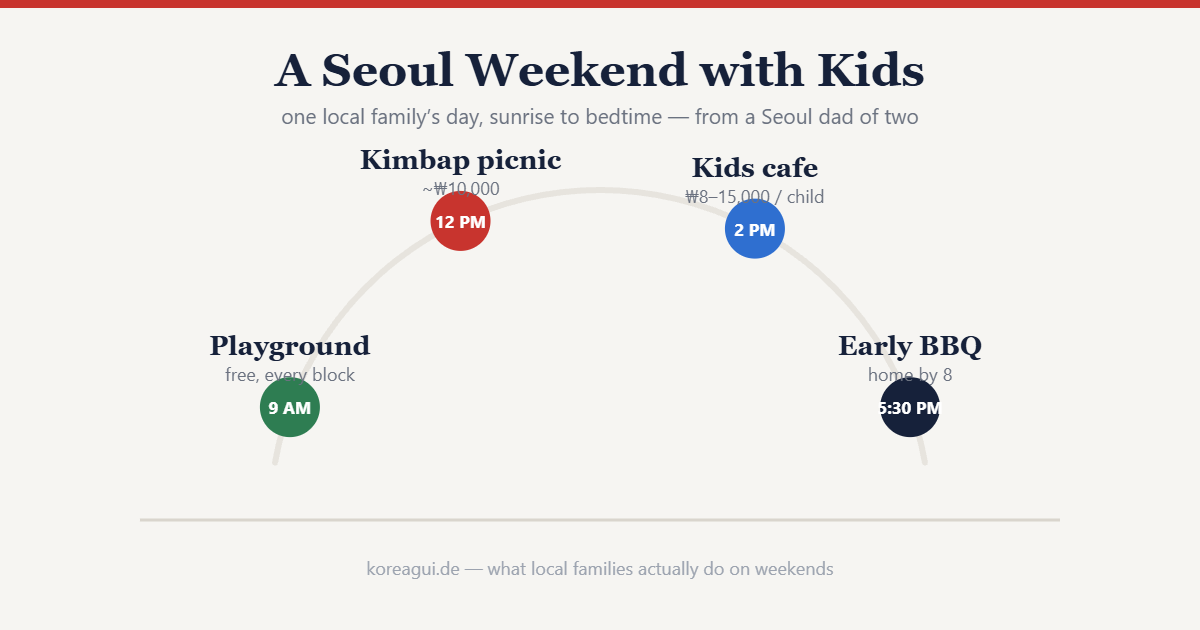
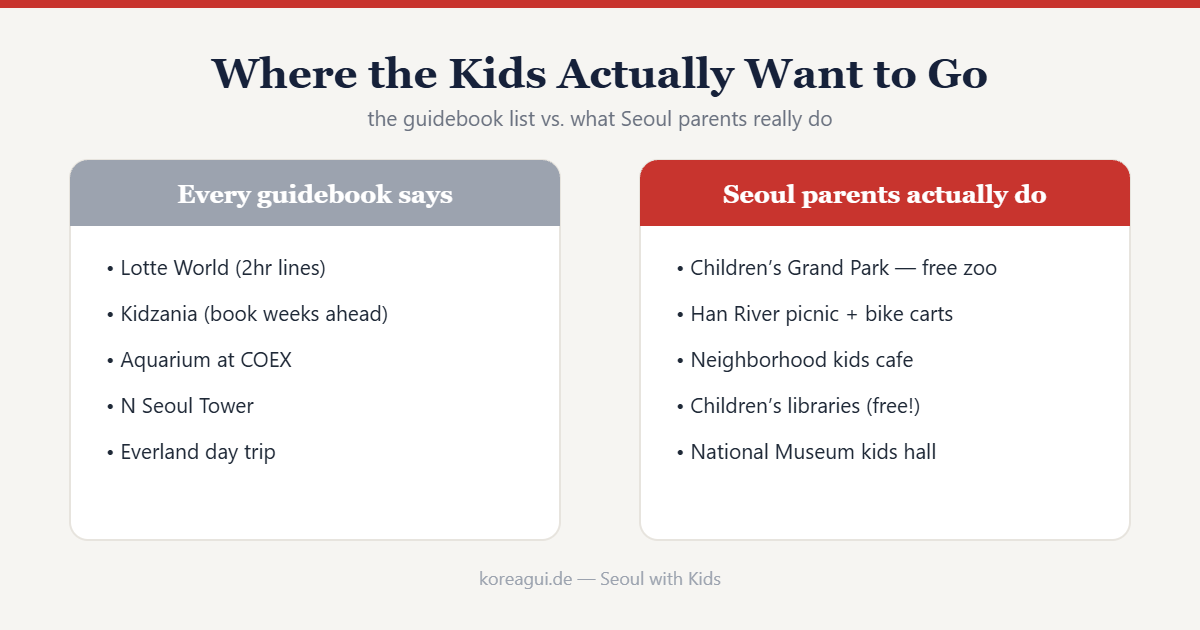
I’m a Seoul dad with two kids — a 9-year-old and a 5-year-old — and I can tell you a secret: almost no Korean family spends their weekend the way the “Seoul with kids” articles tell you to. Lotte World and Kidzania are fine once a year. But if you want your kids to have the weekend our kids actually have — cheaper, calmer, and honestly more fun — here’s the real playbook.
Skip the checklist, copy the rhythm
The guidebook list is built around big-ticket attractions. The local weekend is built around a rhythm: outside in the morning while energy is high, a cheap easy lunch, somewhere indoor in the afternoon when everyone fades, and dinner early enough that nobody melts down. Every Seoul neighborhood is set up to support exactly this pattern — which means you can do it from any hotel or Airbnb, no reservations needed.
Morning: the playground is the attraction
Nearly every apartment block and public park in Seoul has a well-kept playground, and on weekend mornings they fill with local kids. This is free, zero-planning, and — if your child wants Korean playmates — the single best cultural exchange program in the country. For a bigger morning out, locals go to:
- Children’s Grand Park (어린이대공원) — a huge park with a free zoo, botanical garden, playgrounds and picnic lawns. Line 7, its own station. Weekend-morning crowd is almost entirely Korean families.
- Seoul Forest (서울숲) — deer enclosure, insect garden, big lawns, bike paths.
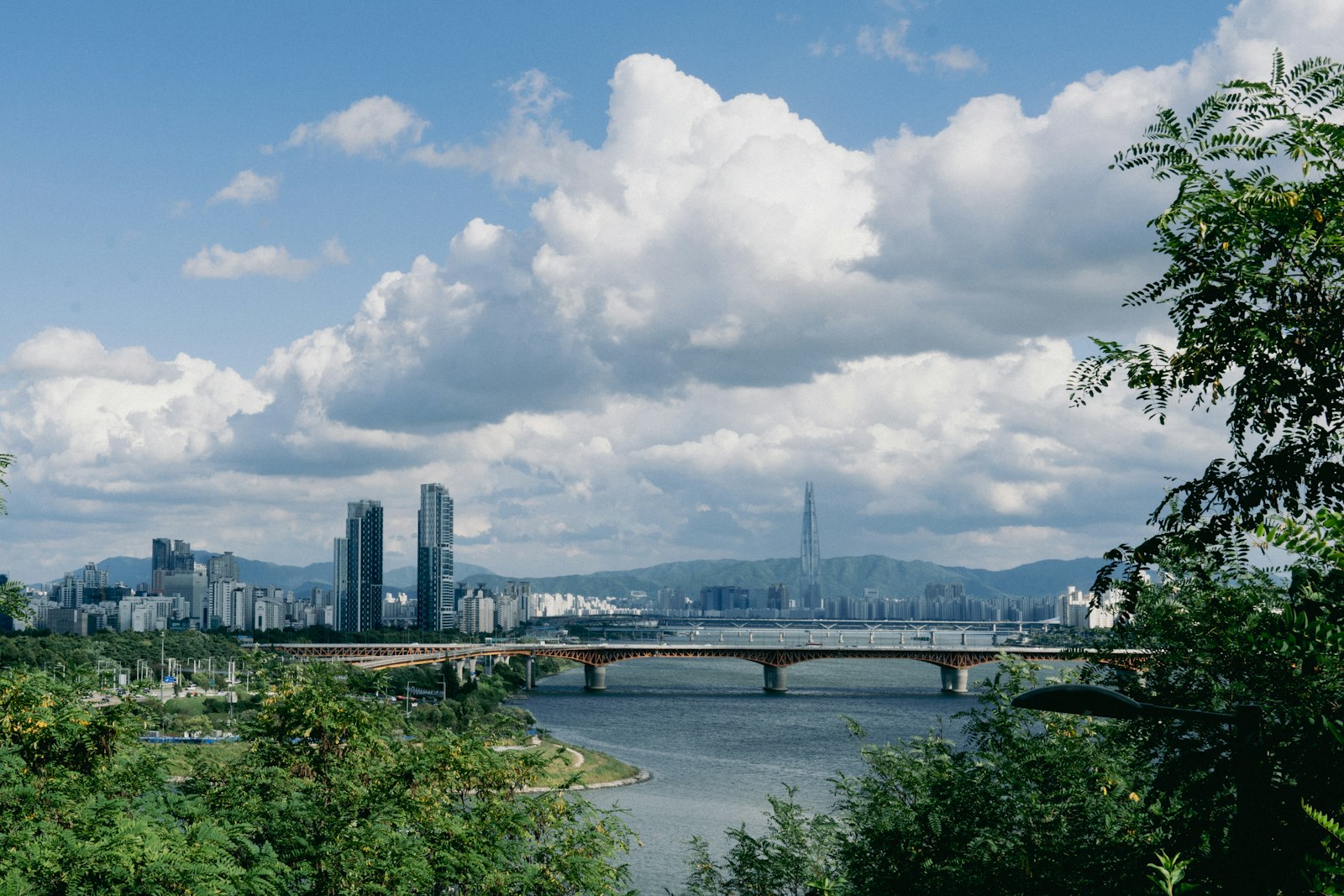
- Han River parks (한강공원) — rent a family bike cart, spread a mat, order fried chicken to your picnic spot like everyone around you.
Lunch: kimbap math
Korean parents don’t do sit-down lunches with tired kids. We grab kimbap (₩3,000–5,000 a roll), fruit and juice from any corner shop, and eat in the park. The alternative is a neighborhood kimbap diner (김밥집/분식집) — fast, cheap, kid-safe menu: kimbap, udon, fried rice, dumplings. A family of four eats for about ₩20,000–30,000.
Afternoon: the kids cafe, Korea’s secret weapon
If you learn one Korean parenting institution, make it the kids cafe (키즈카페): an indoor play center with ball pits, climbing structures, toy rooms and role-play zones — with a real cafe attached where parents sit with a coffee and actual wifi. They are everywhere (search 키즈카페 on Naver Map or Kakao Map), no booking needed.
- Cost: usually ₩8,000–15,000 per child for 2 hours; adults often ₩3,000–5,000 including a drink credit.
- Socks are mandatory — for kids and adults. Forgot? They sell them at the counter. (Every Korean parent has bought emergency socks.)
- Age zones: most have a separate toddler area, which is what makes them work for an elementary kid + preschooler combo — one ticket, both happy, parents seated.
Free indoor backups locals swear by
- Children’s libraries (어린이도서관) — nearly every district runs one, free, with shoes-off reading floors and English picture-book shelves. Rainy-day gold, and tourists never think of them.
- National Museum of Korea Children’s Museum — free with timed entry (reserve online); hands-on history for kids while adults enjoy one of Asia’s best museums upstairs.
- Seoul Children’s Museum (서울상상나라) at Children’s Grand Park — a full hands-on science-and-play building; small admission, book a slot on busy weekends.
Evening: eat at 5:30, not 7:30
Korean BBQ with kids works great if you go early — around 5:30 the restaurant is quiet, staff dote on children, and nobody minds the noise. Order samgyeopsal for adults, plain rice + gyeran-jjim (steamed egg) + grilled meat cut small for kids. Then one last round at the playground on the walk home. That’s the whole trick: end the day the way it started.
Eating out with kids: what actually works
Korean restaurants are far more child-tolerant than their serious exteriors suggest — ours grew up in them. The practical tricks: ask for gyeran-jjim (steamed egg, mild and loved by every Korean child), plain rice with gim (seasoned seaweed sheets — the universal Korean toddler food), and scissors, which every table already has for cutting noodles and meat into kid-sized pieces. High chairs exist at most family restaurants but not everywhere, so a quick peek inside before sitting down saves trouble. Spice is the only real landmine: anything glowing red is off the kids’ menu, but Korean food has a huge mild repertoire — bulgogi, galbitang, kimbap, mandu, japchae. And when all else fails, every convenience store sells bananas, milk, rice balls and yogurt; no Korean parent considers a GS25 dinner-rescue a failure.
Getting around with small kids
The subway is your friend with one caveat: find the elevator before you commit to a station. Most stations have them, but some older ones hide a single elevator at one far exit — Naver Map lists elevator exits per station, which is worth the ten-second check with a stroller. Kids under 6 ride the subway free, and nobody will blink at a folded stroller on board outside rush hour. Buses are harder with wheels and better skipped. Taxis are the secret weapon for tired-kid emergencies: cheap by global standards, everywhere, and hailed in two taps on the Kakao T app. One cultural note — strangers, especially older Koreans, will smile at, talk to, and occasionally hand snacks to your children. It’s warmth, not weirdness; a smile back is the correct response.
What to pack for a Seoul day out
Less than you think. Spare socks for everyone (kids cafes, you’ve been warned), a small pack of wet wipes, and that’s genuinely most of it — because the city itself is your supply cabinet. Convenience stores every hundred meters cover snacks, drinks, umbrellas and emergency toys; Daiso stores (₩1,000–5,000 shops, everywhere) cover forgotten hats, coloring books and bribery-grade stickers; and department store basements have proper nursing rooms and changing facilities, free to walk into. Public restrooms in subway stations are clean and common. Seoul is, quietly, one of the easiest cities in the world to parent in — pack light and let the city carry the bag.
FAQ
Do kids cafes allow foreign visitors?
Of course — pay at the door like anyone. Staff English is limited but the system is obvious, and other parents will help.
Is Seoul stroller-friendly?
Subway stations mostly have elevators (check exits on Naver Map); buses are harder. Big parks and museums are excellent.
What about different-aged kids (like mine)?
Kids cafes with toddler zones, Children’s Grand Park, and Han River picnics are the three formats where a 9-year-old and a 5-year-old are both fully entertained. That’s why locals default to them.
Prices are typical ranges as of October 2026 and vary by venue. Written by a Seoul parent, not a tourism board.