
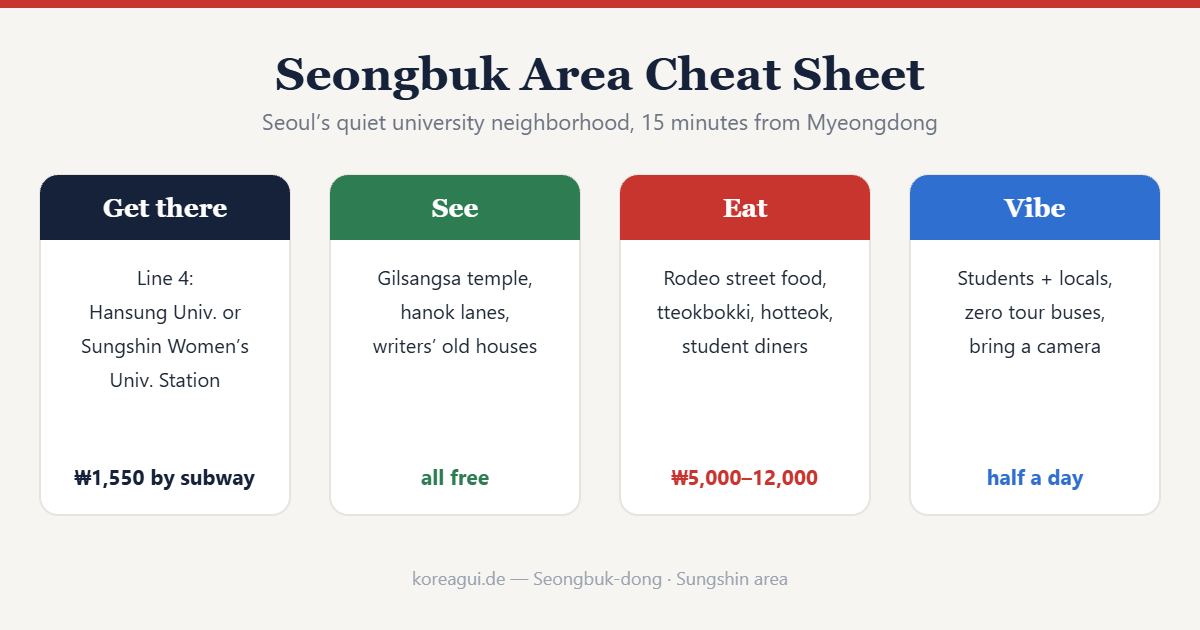
I’ve walked through this neighborhood nearly every day for a decade — I work at the university that gives the area its name — and I’ve still never seen it in an English guidebook. Seongbuk-dong (성북동) and the Sungshin Women’s University area sit just two subway stops north of the old city, on the far side of Seoul’s ancient wall: hillside hanok lanes, a famously beautiful temple, tea houses in writers’ old homes, and a student food street where dinner costs less than a Myeongdong coffee. Here’s the half-day version, exactly as a local would walk it.
Why this neighborhood, of all places?
Seongbuk-dong was where Seoul’s writers, artists and (later) ambassadors chose to live — quiet, leafy, and built against the mountain. The result today is a rare combination: genuinely old Korea within sight of downtown, with almost no tour-bus traffic. Pair it with the Sungshin university district next door and you get the full contrast in one afternoon — contemplative morning, youthful evening.
The half-day route
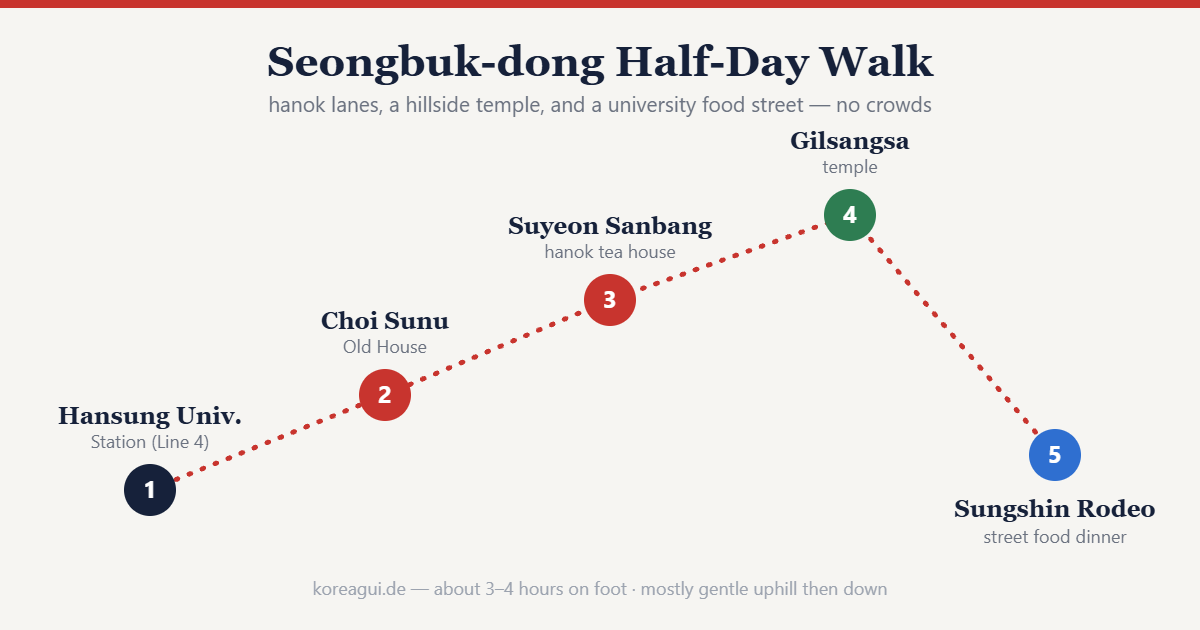
Start: Hansung University Station (Line 4), exit 6. Walk north up Seongbuk-ro — the road climbs gently and the city noise drops away almost immediately.
- Choi Sunu Old House (최순우 옛집) — the preserved hanok home of the great art historian who ran the National Museum. Small, free, and the best five-minute lesson in why Korean architecture values restraint. (Closed in winter months and Mondays — if the gate’s shut, the lane itself is worth the detour.)
- Suyeon Sanbang (수연산방) — a 1930s writer’s hanok turned tea house, with a garden courtyard that looks unchanged in ninety years. Order the traditional sweet-pumpkin porridge or a quince tea; this is the place to sit for an hour. Expect ₩10,000–15,000 per person — the one “splurge” of the day.
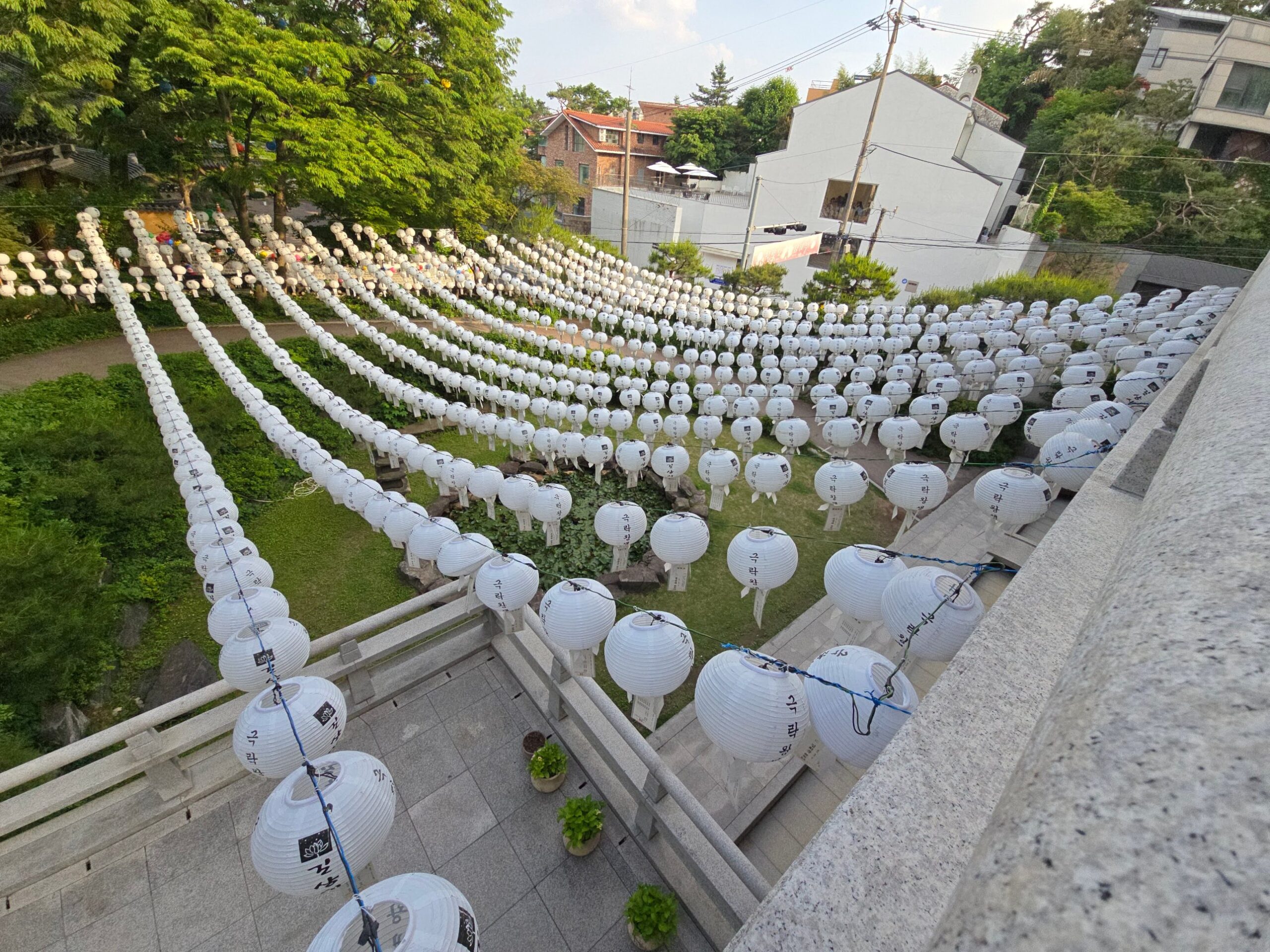
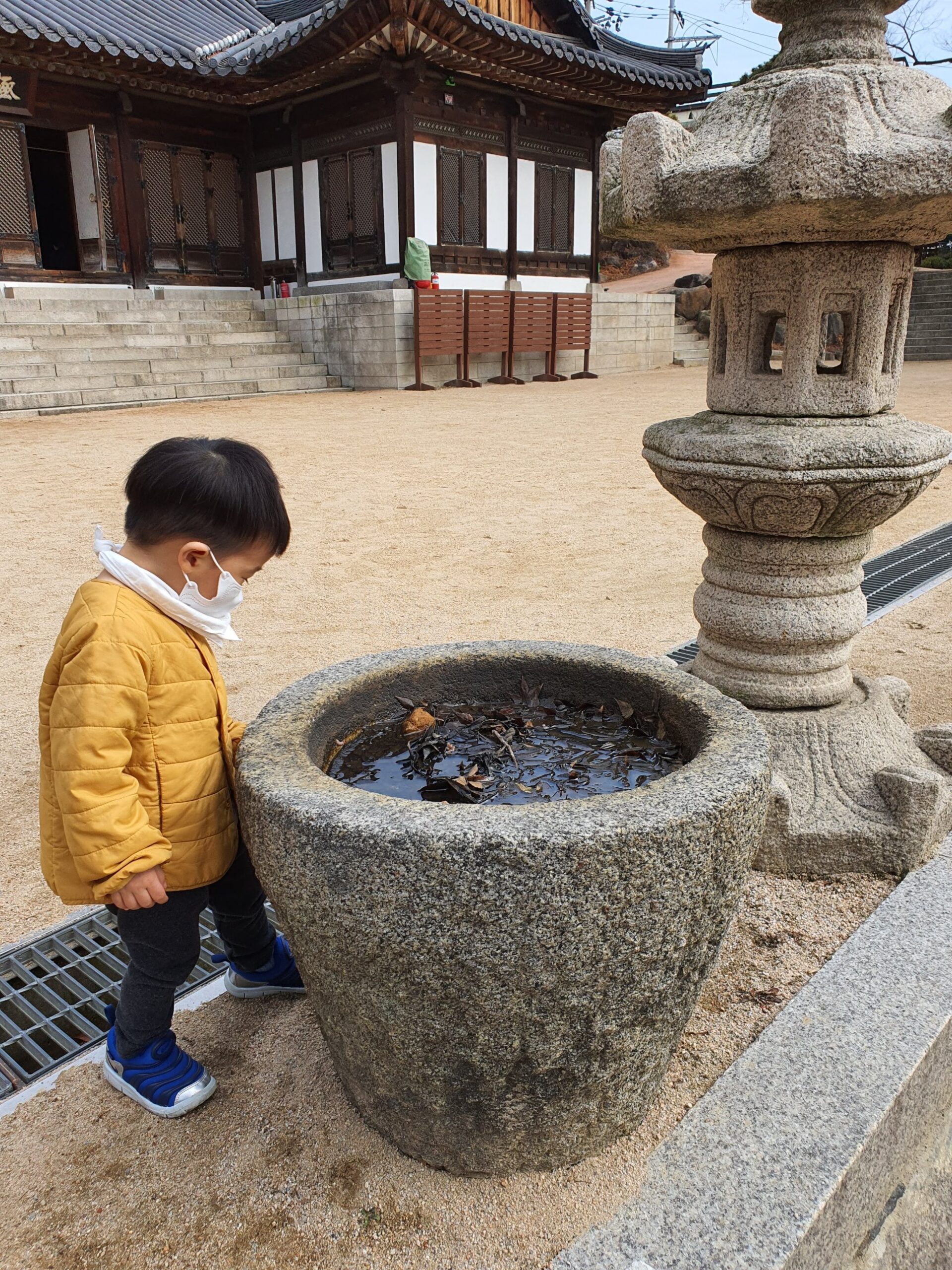
- Gilsangsa (길상사) — the neighborhood’s crown: a hillside temple that was, famously, once Seoul’s most exclusive restaurant before its owner donated it to become a temple. Free entry, open daily, gorgeous in every season — lanterns in May, maples in November. The quiet here on a weekday is absolute.
- Downhill to Sungshin Women’s University Station — bus 1111 or 2112 drops you near the station area, or it’s a pleasant 25-minute walk down.
- Sungshin “Rodeo” street (성신여대 로데오) — finish in the student quarter: cheap and excellent tteokbokki, hotteok and fried chicken, cosmetics shops, and cafes priced for students, not tourists. Dinner for two under ₩20,000 is normal here.
When to come
- Weekday afternoons are the sweet spot — Gilsangsa nearly empty, tea house tables free.
- Late May (temple lanterns) and early November (maple season) are the two postcard windows.
- Avoid Mondays if the historic houses matter to you — several close.
Local notes
- This is a residential neighborhood — the hanok lanes are people’s homes, so keep voices down and skip the drone.
- Wear comfortable shoes: the Seongbuk-dong side is one long gentle hill.
- Cash is unnecessary — even the smallest tteokbokki stall takes cards.
- Nearby add-on: the Hanyangdoseong (Seoul City Wall) trail passes right above the neighborhood if you want to extend into a proper hike.
A coffee crawl worth the hill
Seongbuk-dong’s cafe scene is the opposite of Seongsu’s warehouse hype: small rooms in old houses, owners who roast their own beans, and windows that look onto stone walls instead of queues. The pattern to follow is simple — walk the main road (Seongbuk-ro) uphill and duck into whichever side lane looks promising; the best spots are one turn off the main street. Expect hand-drip coffee for ₩6,000–8,000, quiet enough to read, and nobody rushing your table. If you only have time for one stop, make it the tea house at Suyeon Sanbang mentioned above — but the modern cafes on the lanes below Gilsangsa are where the neighborhood’s younger regulars actually sit.
Eating like a student on Sungshin Rodeo
The food street in front of Sungshin Women’s University runs on student budgets, which makes it one of the best value-for-money dinners in northern Seoul. What to order, roughly in the order a local would: tteokbokki from a street cart or sit-down joint (₩4,000–6,000 a portion, often with free broth refills), fried chicken shared over drinks, hotteok (sweet filled pancakes, ₩1,500–2,000) from the stall with the longest line, and cheap noodle shops where a full bowl runs under ₩8,000. The street is liveliest on weekday evenings when classes let out; weekends are calmer. Most places have picture menus, every one of them takes cards, and portions assume a college appetite.
If you have a full day
The half-day walk extends naturally in two directions. Above the neighborhood runs the Hanyangdoseong (Seoul City Wall) trail — join it near Hyehwamun Gate and you can walk the old fortress line with the city spread out below; the Seongbuk section is one of the quietest stretches of the entire wall. Downhill to the south, one subway stop (or a 20-minute walk) brings you to Hyehwa / Daehangno, Seoul’s small-theater district, good for an evening show or a livelier dinner. And if you’re heading back toward the palaces, the bus along Changgyeonggung-ro drops you at Changdeokgung‘s back gate — meaning you can do hanok lanes, a fortress wall, and a UNESCO palace in a single unhurried day without ever touching a crowded tourist shuttle.
Staying in the area
There are no big hotels here, and that’s rather the point. Options cluster around the two Line 4 stations: guesthouses and small hotels near Hansung University Station for the quiet end, more budget rooms and officetel-style stays near Sungshin Women’s University Station for the livelier end. Nightly rates run noticeably below Myeongdong or Hongdae for equivalent rooms, and you wake up somewhere that feels like Seoul rather than a duty-free corridor. The trade-off is fewer English-speaking front desks — booking through the usual apps smooths that over. If your trip is mostly palaces and northern Seoul, the location is quietly brilliant: Line 4 reaches Myeongdong in about 15 minutes and Seoul Station in about 20.
FAQ
Is it worth staying in this area?
If you prefer quiet mornings and real neighborhood life over nightlife, yes — Line 4 puts Myeongdong 15 minutes away.
Do I need to book anything?
Nothing. The whole route is walk-in. That’s the point.
Is English spoken?
Less than in tourist districts — menus at student spots are Korean-first. Papago handles the rest, and prices are low enough that ordering adventurously is cheap.
Written by someone who commutes through this neighborhood daily. Opening days and prices as of October 2026 — check hours for the historic houses before a special trip.