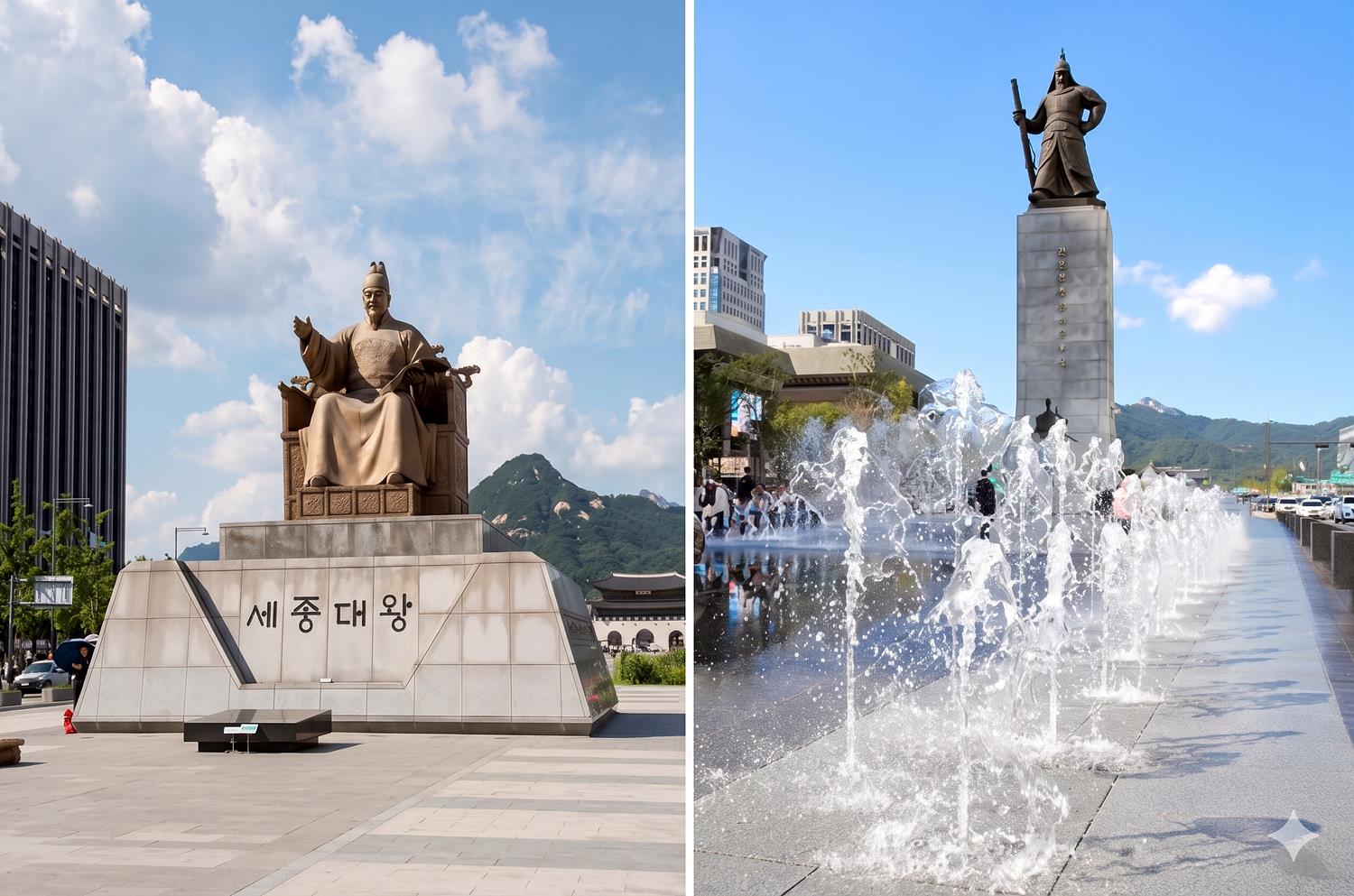
Every capital has its front yard. Seoul’s is Gwanghwamun Square — a 600-meter stretch of open space running from the gates of Gyeongbokgung Palace down toward City Hall, with a mountain standing guard at one end and two giant bronze Koreans watching over the middle. Most visitors cross it on their way to the palace without realizing they’re walking the oldest street in Seoul, one that has had the same job — the center of Korean power — for over six centuries. Here’s how to read it.
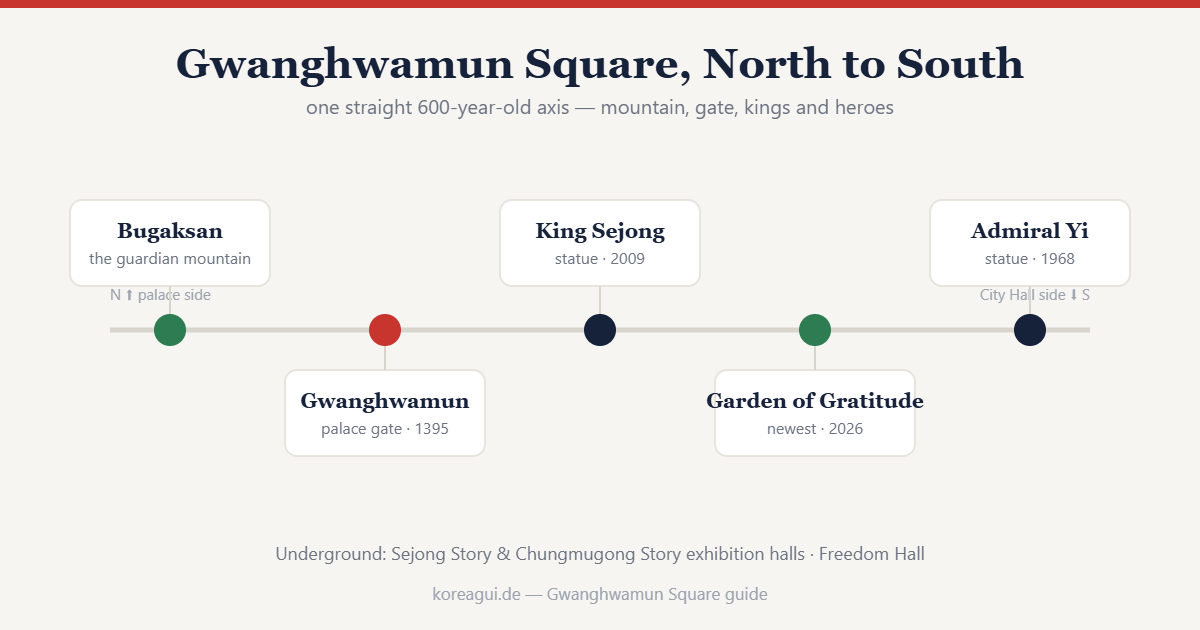
Six hundred years, same job
When the Joseon Dynasty laid out its capital in 1395, the boulevard in front of the palace was called Yukjo Street — “Street of the Six Ministries” — because the kingdom’s government offices lined both sides. Walk it today and the tenants have barely changed: the Government Complex Seoul towers over the west side, the Ministry of Foreign Affairs sits nearby, and the U.S. Embassy faces the square. Korea has had kings, colonizers, dictators and democracies, and through all of it, this one street kept its job. That’s also why the square doubles as the nation’s living room — this is where Koreans gather for World Cup cheering, candlelight protests, festivals and New Year celebrations alike.
Gwanghwamun: the gate that kept coming back
The square’s namesake gate — the grand southern entrance to Gyeongbokgung Palace — may be the most stubborn building in Korea. Built in 1395, burned in the 1590s Japanese invasions, rebuilt in 1867, dismantled and shoved aside by the Japanese colonial government, destroyed again in the Korean War, rebuilt in concrete in 1968, and finally restored properly in wood in 2010. In 2023 it got its finishing touches: the woldae, a raised ceremonial stone platform extending in front of the gate (the king’s red carpet, in stone), and a new name plaque in gold characters on black, recreated from old photographs. Time your visit to catch the Royal Guard Changing Ceremony at the gate — held twice daily (typically 10:00 and 14:00; no ceremony Tuesdays, when the palace closes) with full Joseon-era costume and drums. It’s free, and it’s the best photo op on the square. More on the city’s other historic gates in our Four Great Gates guide.
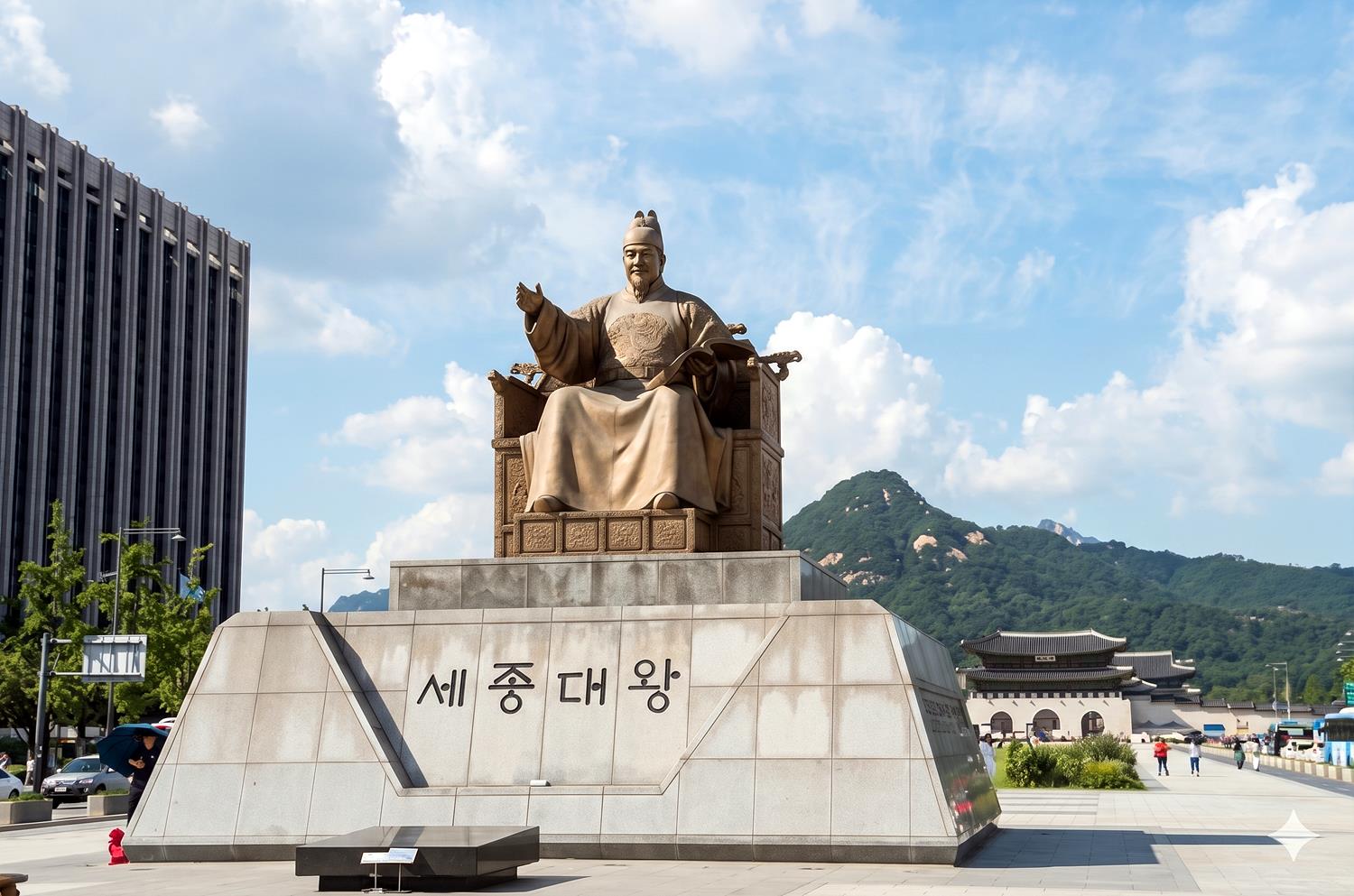
King Sejong: the man on the money, and on the square
The golden seated figure facing you as you look toward the palace is King Sejong the Great (reigned 1418–1450), the most beloved monarch in Korean history and the face of the ₩10,000 bill. His claim to immortality: he led the creation of Hangul, the Korean alphabet — arguably the only writing system on Earth whose inventor, purpose and launch date (1446) are all documented. The statue, unveiled on Hangul Day in 2009, holds a book and raises an open hand, and the bronze objects in front of it aren’t decoration: they’re his administration’s inventions — a rain gauge, a sundial and a celestial globe. Don’t miss the entrance behind the statue leading underground to “The Story of King Sejong,” a free exhibition hall beneath the square (run by the Sejong Center).
Admiral Yi Sun-sin: twelve ships against three hundred
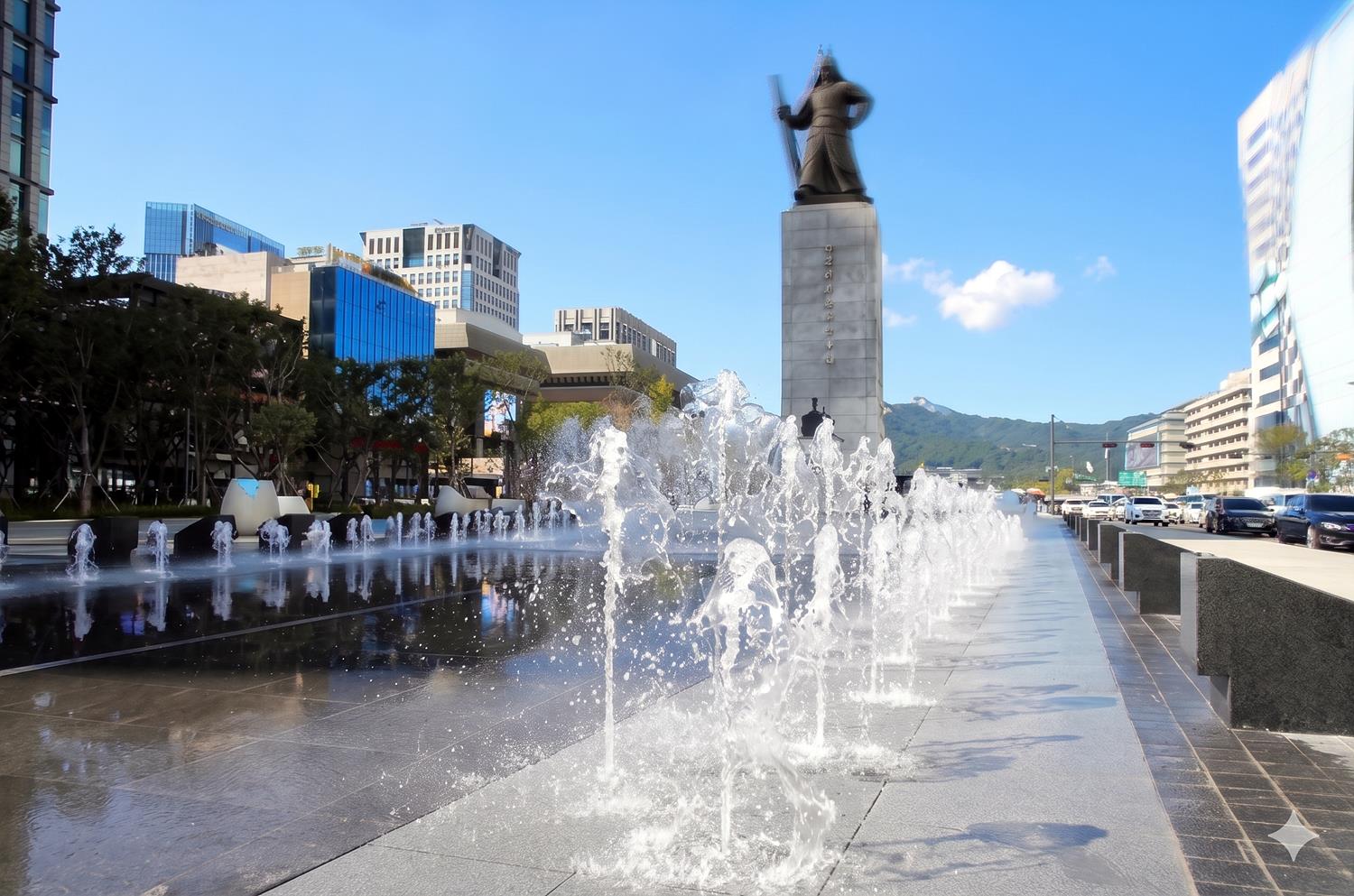
Further south stands the square’s older guardian: Admiral Yi Sun-sin (1545–1598), sword in hand since 1968. Foreigners often walk past without knowing they’re looking at one of history’s most extraordinary naval commanders — undefeated in over twenty engagements against the Japanese fleet, most famously at Myeongnyang in 1597, where he faced a fleet of over a hundred ships with just twelve and won. His turtle ship (a replica sits below the statue) is considered an early armored warship. The fountain in front is named 12·23 — twelve ships, twenty-three battles. In summer it becomes Seoul’s most democratic water park: office workers eating lunch on one side, soaked children shrieking through the jets on the other. His underground exhibition, “The Story of Admiral Yi,” connects to the Sejong hall.
The Garden of Gratitude: the square’s newest chapter
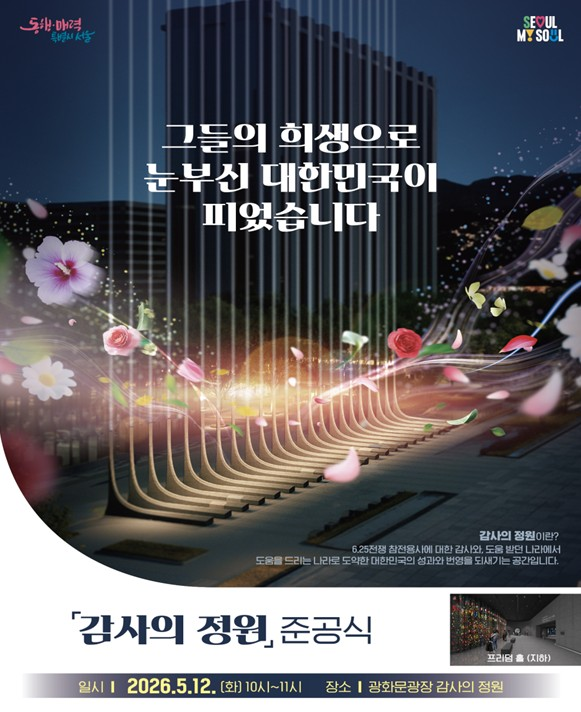
The square’s latest addition opened in May 2026, diagonally behind the Sejong statue: the Garden of Gratitude, honoring the 22 nations that fought or sent aid under the UN flag in the Korean War. Its centerpiece is “Light of Gratitude 23,” a 6.25-meter sculpture inspired by the rifle-salute gesture, built partly with stones donated by the participating countries, with an underground media space called Freedom Hall. Like most things built on this square, it arrived with lively public debate — the site originally slated for a giant flagpole — which is itself very Gwanghwamun: for 600 years, whatever Korea is arguing about, it argues about here. If the subject interests you, the War Memorial of Korea in Yongsan offers the full story in museum form.
Visiting the Garden: the 23 pillars of “Light of Gratitude 23” are arranged in a single north–south line in order of when each nation entered the war — the United States at the southern end, Korea itself at the northern end — so walking the row is literally walking the war’s timeline. Come after dark for the nightly light show: every evening from 8–11 pm (7–10 pm in winter), the pillars light up for ten minutes every half hour. Free guided tours — including in English — run Tuesday to Sunday (10 am–8 pm, about 12 sessions a day, 20 people each; book via the Seoul Public Service Reservation site), and the underground Freedom Hall with its interactive media exhibits is open for self-guided visits anytime. All of it is free.
Museums within a ten-minute walk
| Museum | Why go | Cost |
|---|---|---|
| National Palace Museum of Korea | Royal treasures of the Joseon Dynasty, right beside the palace entrance | Free |
| National Museum of Korean Contemporary History | Korea’s wild 20th century — war to tech superpower; great rooftop view of the square | Free |
| Sejong & Admiral Yi exhibition halls | Underground, directly beneath the statues — perfect rainy-day add-on | Free |
| National Folk Museum of Korea | How ordinary Koreans actually lived; inside the palace grounds | Free (palace ticket for access) |
Yes, they’re all free — the square may be the best zero-won half day in Seoul. It slots naturally into day one of our Seoul itinerary, and pairs with the palace for a full morning.
Small details worth slowing down for
The square you’re standing on reopened in 2022 after a redesign that doubled the green space, and it hides some easy-to-miss touches. Along the eastern edge runs a thin channel of water — the stream of history — with the years of Korean history etched beneath your feet, from the dynasty’s founding to the present. Near the palace end, look down for the excavated remains of the old Samgunbu and Uijeongbu government office sites, kept visible under glass right where Yukjo Street’s ministries once stood. In summer, kids treat the ground fountains as a public pool; in winter the space in front of the gate hosts light festivals and a pop-up skating vibe. The square changes costume every season — which is exactly what a 600-year-old living room should do.
FAQ
How do I get there?
Gwanghwamun Station (Line 5, exits 2/9) puts you on the square; Gyeongbokgung Station (Line 3) drops you at the palace end.
How much time should I budget?
An hour for the square and statues; half a day if you add the palace and one museum.
Is it worth visiting at night?
Very — the gate and statues are lit, the crowds thin out, and the view up the axis to the dark mountain is the best free night view downtown.
Written by a Seoul local. Ceremony times and openings can shift with weather and events — check before a special trip. Last checked: October 2026.