
Getting sick in a foreign country is stressful — but Korea is one of the easiest places in the world to get fast, affordable care, even as a tourist with no Korean insurance. I live in Seoul, and this is the same decision path locals use: start at a pharmacy for minor issues, walk into a neighborhood clinic for anything that needs a doctor, and save the hospital ER for real emergencies. Here’s exactly how each one works, what it costs, and how to get help in English.
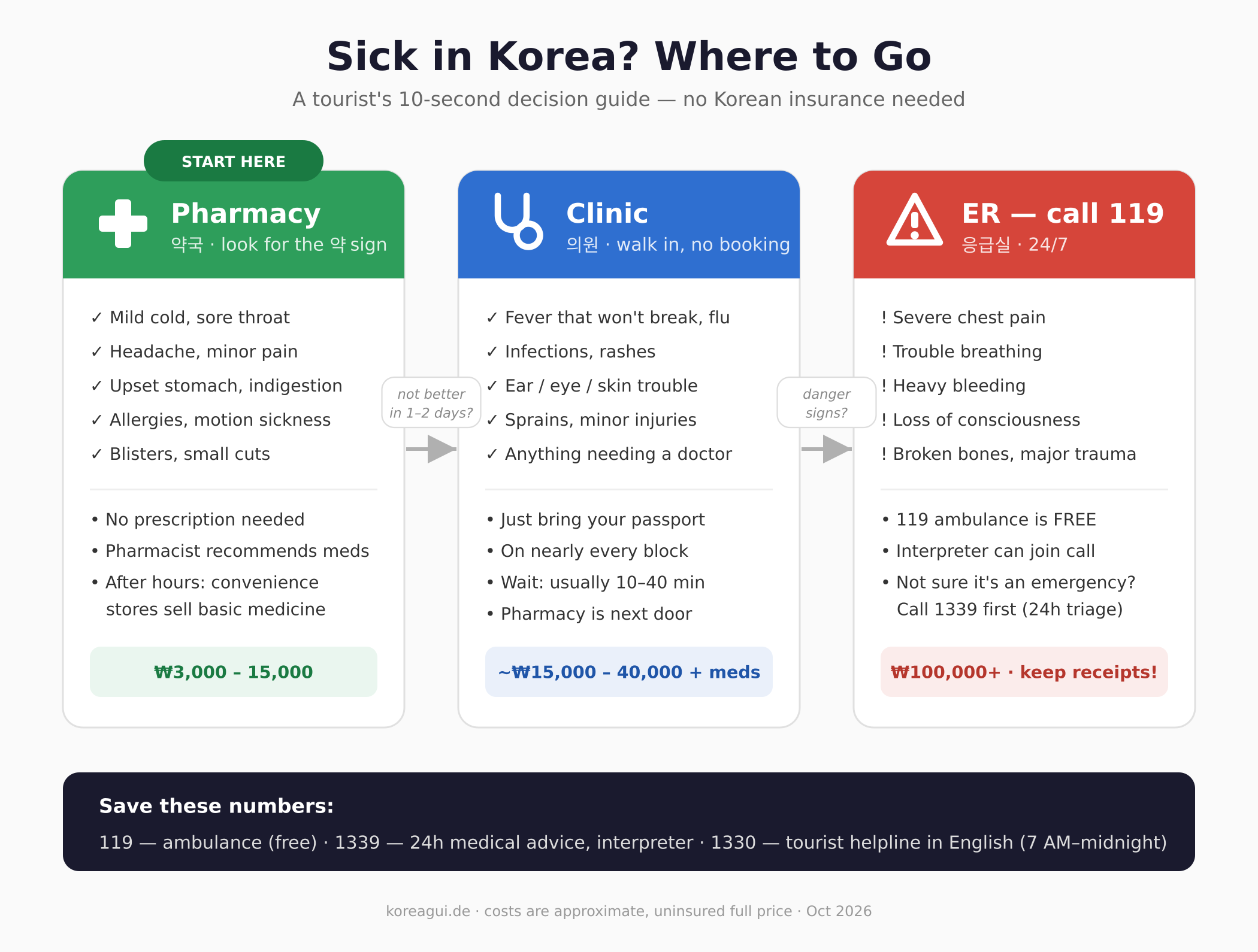
Quick answer: where should you go?
| Your situation | Go to | Typical cost without insurance |
|---|---|---|
| Mild cold, headache, upset stomach, blisters, motion sickness | Pharmacy (약국) | ₩3,000–15,000 for medicine |
| Fever that won’t break, flu, infection, rash, injury that needs a look | Neighborhood clinic (의원), walk-in | ~₩15,000–40,000 consult + medicine (approx.) |
| Chest pain, trouble breathing, heavy bleeding, broken bone, unconsciousness | ER (응급실) — call 119 | ₩100,000+ (approx.); the 119 ambulance itself is free |
Rule of thumb: Korea’s system is built around small private clinics on nearly every block. For anything short of an emergency, a clinic is faster and far cheaper than a hospital ER — even for foreigners paying full price.
Step 1: The pharmacy (약국) — your first stop
Korean pharmacists are highly trained and used to recommending medicine based on symptoms. Walk in, point at your throat or mime your symptom if you have to (or show a translated note — see phrases below), and you’ll usually walk out with exactly what you need in two minutes.
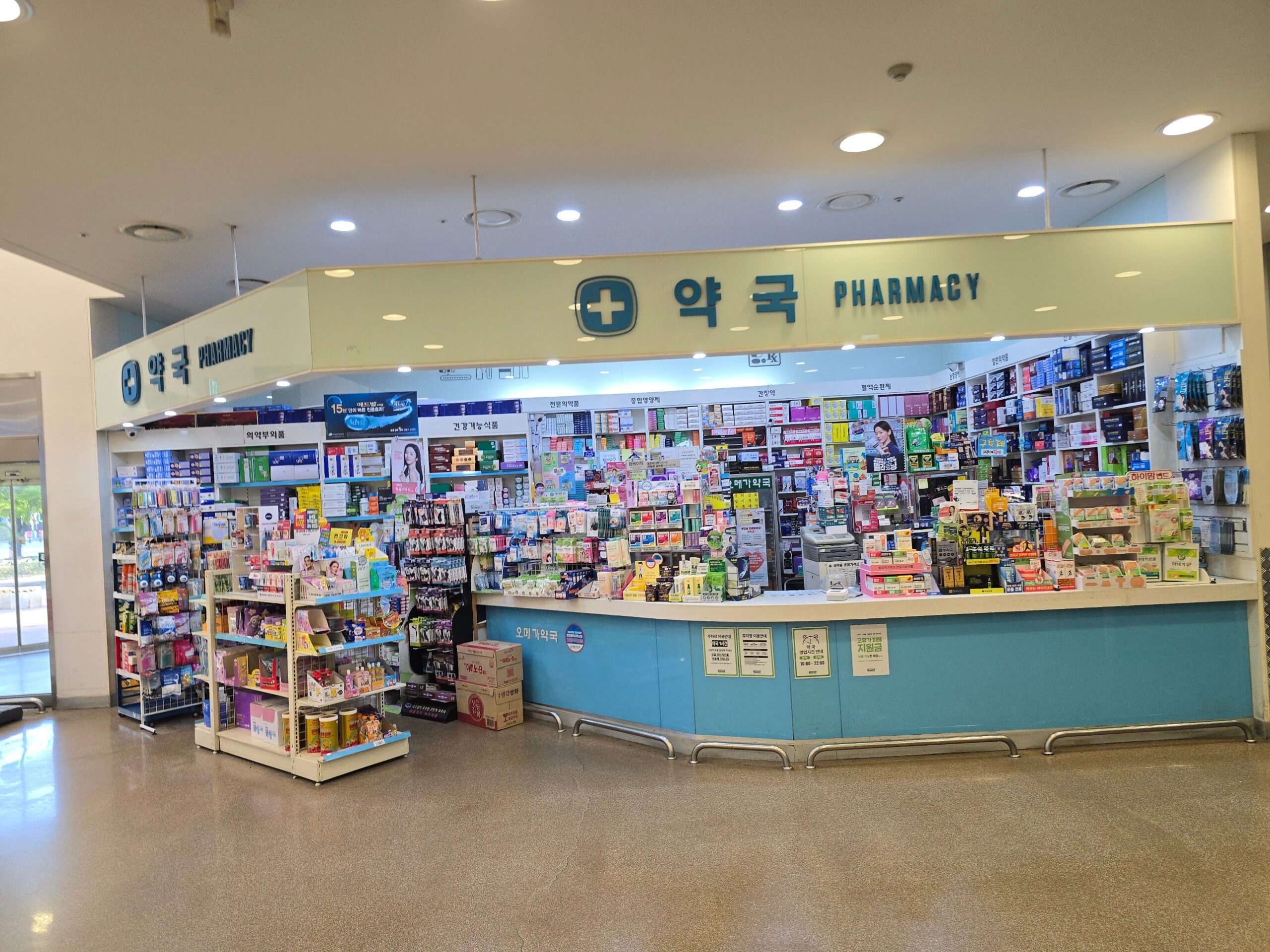
- Look for the sign 약 (yak) — pharmacies are everywhere, usually next to clinics.
- No prescription needed for cold medicine, painkillers, digestive aids, allergy pills, and most everyday remedies.
- Hours: typically weekday 9 AM–6 or 7 PM, shorter on Saturdays, many closed Sunday. Search “야간 약국” (night pharmacy) on Naver Map or Kakao Map for late-night ones, or call 1339.
- After hours: convenience stores (CU, GS25, 7-Eleven) legally sell a small set of basic medicines 24/7 — fever reducers like Tylenol, multi-symptom cold remedies, digestive aids, and pain-relief patches.
If store-bought medicine isn’t fixing it within a day or two, move to Step 2.
Step 2: The neighborhood clinic (의원) — faster than you’d believe
This is the part of Korean healthcare that surprises visitors most. Small private clinics — internal medicine (내과), ENT (이비인후과), dermatology (피부과), orthopedics (정형외과) — sit on nearly every commercial block, and almost all take walk-ins.
How a visit works:
- Walk in and show your passport at the front desk (that’s all you need as a tourist).
- Fill in a one-page form — name, birth date, symptoms. Staff will usually help.
- Wait, typically 10–40 minutes without an appointment.
- See the doctor for a few minutes; many younger doctors read and speak basic medical English.
- Pay at the desk, take your prescription (처방전) to the pharmacy next door, pay again for the medicine.
Cost without Korean insurance: you pay the full fee instead of the insured 30%, but the full fee at a small clinic is still modest by Western standards — roughly ₩15,000–40,000 for a standard consultation at most neighborhood clinics (approximate; it varies by clinic and treatment, so ask at the desk before you’re seen if you’re worried). Medicine on top is usually ₩5,000–20,000. Clinics marked “international” charge noticeably more.
Finding an English-speaking clinic: search “international clinic” plus your district on Naver Map or Google Maps, or call the 1330 tourist helpline and ask them to find one near you — they’ll even interpret over the phone.
Step 3: Hospital & ER (응급실) — for real emergencies
Go straight to an ER, or call 119, for: severe chest pain, difficulty breathing, loss of consciousness, heavy bleeding, suspected broken bones, or any major trauma.
- The 119 ambulance is a free public service — don’t hesitate over cost. Operators may have limited English, but 119 can bring an interpreter onto the call.
- Every general hospital (종합병원) runs a 24/7 ER. Major university hospitals in Seoul — Seoul National University Hospital, Severance, Asan, Samsung Medical Center — have international clinics and English-speaking staff. All are easy to reach by subway — our Seoul public transportation guide covers how.
- Cost without insurance: ERs charge a base emergency-care fee plus treatment, so even a simple visit commonly lands in the low-to-mid hundreds of thousands of won (very roughly ₩100,000–400,000 for minor cases; serious treatment costs more). Keep every receipt — this is exactly what travel insurance exists for.
- At night with a sick child (more family survival tips in our Seoul with Kids guide) that isn’t ER-serious, look for a “Moonlight Children’s Hospital” (달빛어린이병원) — pediatric clinics designated to stay open nights and holidays. Call 1339 to find one.
If you’re unsure whether your situation is ER-worthy, call 1339 first (24 hours) — they’ll triage you over the phone with an interpreter.
Numbers to save before you need them
| Number | What it is | Hours / language |
|---|---|---|
| 119 | Ambulance & fire (free) | 24/7, interpreter can join the call |
| 1339 | Medical advice & triage hotline (KDCA) | 24/7, interpreter via three-way call; also reachable on KakaoTalk |
| 1330 | Korea Travel Helpline (KTO) | 7 AM–midnight, English/Japanese/Chinese and more; helps find clinics and interprets |
| Naver Map / Kakao Map | Search 약국 (pharmacy), 내과 (internal medicine), 야간 약국 (night pharmacy) | Google Maps is unreliable for Korean businesses — use these instead |
Practical tips from a local
- Pay by card. Clinics, hospitals, and pharmacies all take international credit cards; small pharmacies occasionally prefer cash for tiny amounts.
- Get the paperwork for insurance. Ask for a 진료비 영수증 (payment receipt) and, if you’ll claim, a 진단서 (medical certificate — costs extra) or 소견서 (doctor’s note). Your travel insurer will want these.
- Prescriptions are single-use and valid only a few days — fill them the same day at the pharmacy next to the clinic.
- Bring your regular meds’ generic names in English; brand names differ in Korea.
- Useful phrases: 아파요 (apayo — it hurts), 열이 나요 (yeori nayo — I have a fever), 감기약 주세요 (gamgiyak juseyo — cold medicine, please), 영어 가능한 병원 (yeongeo ganeunghan byeongwon — hospital where English is possible). Or just use Papago — every pharmacist has seen a phone screen before.
Dental and eye emergencies
The same three-tier logic applies to teeth and eyes. For a broken filling, a knocked-out crown, or sudden tooth pain, walk into any dental clinic (치과) — they are as common as regular clinics, take walk-ins, and an uninsured consultation typically starts around ₩20,000–40,000 before treatment. For eye trouble — an infection, something stuck in your eye, lost contact lenses — look for an ophthalmology clinic (안과); many double as optician referrals and can see you the same day. Glasses and contacts, by the way, are famously fast and cheap in Korea: most optical shops make prescription glasses in under an hour. For severe trauma to either, skip the clinic and go straight to an ER — major hospitals have dental and ophthalmic staff on call.
Making a travel insurance claim afterward
Korean providers deal with foreign patients routinely, so getting claim paperwork is easy — if you ask before you leave the building. For a simple clinic visit, the itemized payment receipt (진료비 영수증) plus the pharmacy receipt is usually enough for small claims. For anything bigger, also request a medical certificate (진단서, usually ₩10,000–20,000) stating the diagnosis in formal terms; some insurers insist on it for claims above a few hundred dollars. Ask for documents in English if possible — larger hospitals can issue them, small clinics may not, in which case your insurer will accept Korean documents with a translation. Photograph everything before you fly home: receipts fade, and chasing a Seoul clinic for a reissued document from another country is nobody’s idea of fun. If you’re still planning your trip, this is the single best argument for buying travel insurance before you land — more pre-trip essentials in our first-timer’s guide to South Korea.
FAQ
Can tourists see a doctor in Korea without insurance?
Yes. Any clinic or hospital will treat you — you simply pay the full (uninsured) price out of pocket, which at a neighborhood clinic is still typically a few tens of thousands of won.
Do I need an appointment?
Not at neighborhood clinics — walk-ins are the norm. Large hospitals and dedicated international clinics usually require a reservation.
Is the ambulance really free?
Yes, the 119 public ambulance is free. The ER treatment afterward is not.
Can I buy antibiotics over the counter?
No — antibiotics require a doctor’s prescription in Korea. Cold medicine, painkillers, and allergy medication don’t.
Cost figures are approximate uninsured ranges; confirm at the clinic desk. Last checked: October 2026.